











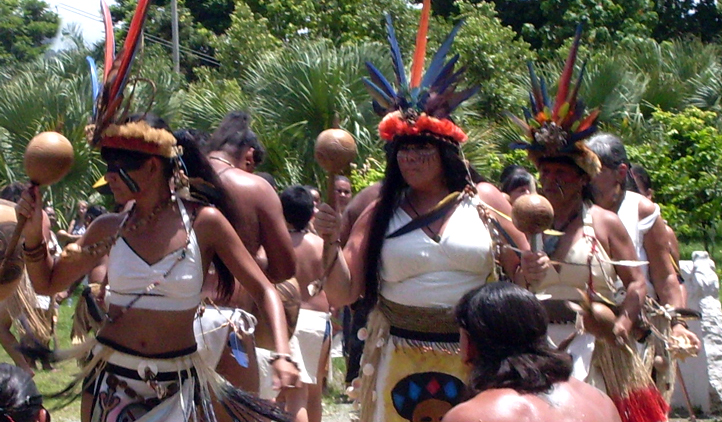
Gracias Rincon Criollo!


Taino History & Tainos Today

Puerto Rico has a rich culture whose origins can be traced back to native Taino, Spanish and West African roots. While we know much about our Spanish and African roots, our Puerto Rican community at large knows little about our Taino Heritage.

Christopher Columbus landed in Puerto Rico on his second voyage to the New World (November 19, 1493). At that time the Island was populated by a peaceful, gentle indigenous people, Tainos, who called the island Boriken, the Great Land of the Valiente and Noble Lord. They lived in small yucayeques (villages) led by a Cacike (chief) and subsisted on hunting, fishing and gathering of native cassava root and fruits. At the center of every yucayeque was a big batey (plaza) where the Tainos played a sport called batu and held important ceremonies that fed their deep sense of spirituality including areytos, religious ceremonies with music and dancing. Facing the plaza was a caney, a rectangular-shaped home that belonged to the Cacike. Completing the circle around the batey were bohios, round homes of bamboo and palm that belonged to the Tainos of the village.

The Tainos welcomed the Conquistadores, shared their homes and food and gave the Spaniards many gifts. The Spaniards treated the indigenous population severely, enslaving and exploiting them, forcing them to work in mines to search for gold, in construction, and in agriculture. The Taino population rapidly declined from the slave labor conditions and the new European diseases for which they had no immunity, in addition to outright being slaughtered. Some took their own lives to escape the brutalities and indignities that were being repeated on other islands across the Caribbean.

History recorded that by the mid-sixteenth century the Spanish Conquest had decimated Puerto Rico's indigenous people, and declared the Taino extinct by the late eighteenth century. However, as we know "history is written by the victors" (Winston Churchill) -- in reality, Taino were not completely extinguished. Petroglyphs in mountain caves and restored ceremonial grounds testify that they escaped high into the Cordillera Central, the mountain range that runs across the central interior region of Puerto Rico, while others escaped from the island in canoes. In addition, a census in 1514 found that 40 percent of the officially recognized wives of Spanish men were Taina.

Because of this, it's not surprising (in retrospect) to learn that in his year 2000 National Science Foundation research, Juan Carlos Martinez Cruzado, Professor of Genetics at the University of Puerto Rico-Mayaguez, found that 61 percent of all Puerto Ricans carry Amerindian mitochondrial DNA from their maternal lines. In other words, Tainos were assimilated, not extinguished! This assimilation allowed Taino traditions to survive, handed down from mother to child: the food they ate, how they were raised, home remedies when they didn't feel well, spiritual beliefs, songs, music, dances, storytelling time and other traditions Taino mothers taught their children became a permanent part of our island's heritage. Musical instruments such as maracas and guiro, names of animals like iguana and manatee, words like huracan (hurricane), the hamaca (hammock), tabaco (tabacco) and barbacoa (barbeque) are part of that legacy. To this day, there are many people who use medicinal plants and farming methods that come directly from Taino traditions. In addition to language and traditions, there is much about the character of the Puerto Rican people that can be identified with the human nature of the Taino.

In addition to intriguing, present-day DNA statistics, in Puerto Rico and other islands of the Caribbean, actual surviving Native communities and numerous families of Native ancestry are increasingly revealing themselves. A 2002 study by the Smithsonian Institute's National Museum of the American Indian documented families in high mountain regions across the Caribbean where the inheritance and legacy of Taino ancestors are still present. These descendents hold land and retain a social and spiritual culture that has been passed down through the generations from very early contact times. They live indigenous lives and have preserved traditions including the preparation of cassava bread, traditional weaving, instrument making and other artisania, canoe crafting, and the observance of important ceremonies. In addition to those who can trace their traditions directly to their own Taino family roots, over the last 20+ years there has been a "resurgence" of people who are "waking up" to a calling to learn more about their Taino ancestors and heritage.

Taino culture is very much alive in all of Puerto Rico, through our vocabulary, music, customs, culture, beliefs and the nature of our people. For that reason, it is important that we learn more about our first root, our Primera Raiz. We cannot be a complete people without knowing the Taino History that is part of our fabric and the legacy of Taino traditions that we still enjoy today.


REFERENCES

Photo Credits: Photos of The Concilio Taino Guatu Ma Cu A Boriken by Hilda Morales & Taino Nation. Copyright protected photos, used with Permission.

Wagenheim, Kal and Jimenez de Wagenheim, Olga, "The Puerto Ricans: A Documentary History," Markus Wiener Pub., 1996.

An Interview On the Taino DNA testing in Puerto Rico Of Juan Carlos Martinez, Delware Review of Latin American Studies, "Profiles", Vol. 1, no. 2, 15 August 2000. From Hartford World History Archives: http://www.hartford-hwp.com/archives/41/308.html

Surviving Columbus in Puerto Rico: the myth of extinction, Editorial in Indian Country Today, 06 October, 2003.

"The New Old World: Antilles Living Beyond the Myth," Smithsonian National Museum of the American Indian, 2002. http://www.nmai.si.edu/exhibitions/the_new_old_world/

Irving Rouse, "The Tainos: Rise and Decline of the People Who Greeted Columbus," Yale University Press, 1992.

Antonio M Stevens-Aroyo, "Cave of the Jagua," University of Scranton Press, 2006.

Ricardo Alegria, "History of the Indians of Puerto Rico," Editorial Collection de Estudios Puertorriquenos, 1970.


For more information:
Dr. Ana Maria Maynard, Director
Puerto Rican Folkloric Dance & Cultural Center

Center Location: 701 Tillery Street, Austin TX 78702-3740
Mailing Address: 15228 Quiet Pond Court, Austin TX 78728-4555
Phone: +1.512.251.8122
Email: dance@prfdance.org          Web: www.prfdance.org

Please do not take (or link to) our photos, graphics or text, without our permission.
Using our photos/materials without telling people who we are is not very nice and breaks the Copyright law!

Please read how you can use our website resources correctly.

Copyright ©1997-2008 Puerto Rican Folkloric Dance, Inc. All rights reserved. Terms of use.