











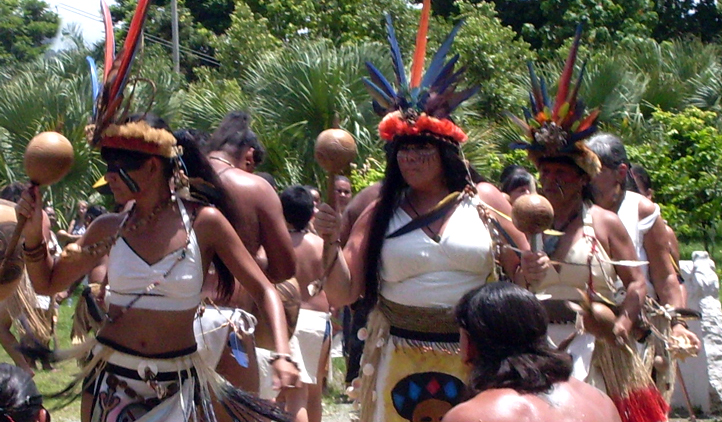
The Taino were the indigenous people of the Caribbean, millions in number who inhabited the islands of Puerto Rico to parts of Florida at the time of the European arrival in the late 15th century. The Conquistadors explored Puerto Rico on Columbus' second voyage to the New World, November 19, 1493 and were greeted by generous and peaceful Taino who called the island Boriken, Great Land of the Valiente and Noble Lord.
The Taino had a lively intelligence and a pure mind with a natural goodness that shined through. They lived in small yucayeques (villages) led by a Cacike (chief) and subsisted on hunting, trading, fishing and gathering of native cassava root and fruits. The Taino held a deep sense of spirituality that was present in every aspect of life, their spirituality centering on a complex system of Cemis. They held many ceremonial events including areytos (dances) in the batey (ceremonial plaza) that was located at the center of their yucayeque surrounded by their bohios (homes).
The Taino population rapidly declined from slave labor conditions brought on by the Conquest, and new European diseases for which they had no immunity. Horrific numbers were slaughtered and many took their own lives to escape the brutalities. In 1511, the TaÃno of Boriken launched a major armed rebellion against Spanish colonizers. Accomplished warriors with guerilla tactics, they fought the colonizers for 18 years. Unfortuntately, their traditional weapons, wooden macanas, and bows were no match for the Conquistadors steel, horses and firearms.
By 50 years after the Conquest, history recorded the Taino extinct. In reality, Taino communities survived by escaping high into the Cordillera Central mountain range. By 1514, 40% of recognized wives of the Spaniards were Taino. The Taino suffered a paper-extinction in 1800, when thousands of full-blooded Taino who still lived in the mountain regions were erased from record when the "Indian" category was dropped from the census. However, in 1899, a US War Dept Census reported that "Indian types" were (still) everywhere in the mountain settlements.
Because of this history, it's not surprising to learn that 61% of all Puerto Ricans carry Amerindian mitochondrial DNA from their maternal lines -- just from their mother's side. Tainos were not extinguished -- many mountain families retained unbroken remembrance of identity and traditions. The Jibaros were the continuation of the Taino. Taino traditions survived, handed down from mother to child and are a permanent part of our island's heritage, our vocabulary, music, customs, culture, beliefs and the nature of our people.
Today Taino living traditions are in restoration and celebrated. There's a "resurgence" on the Island and on the Mainland -- of Taino descendants who are "waking up" to a calling to reconnect to their heritage -- and it grows stronger every day. For that reason, it is important that we learn about our first root, our Primera Raiz. We are not a complete people without understanding the Taino legacy that is part of our fabric, and the traditions that we still enjoy today. Here are Taino Resources to learn more.
REFERENCES